LyricFluent: Learn Spanish
- 4.8
- Rating
- 100.00K
- Installs
- Free
- Price

 Analysis by App-foxy
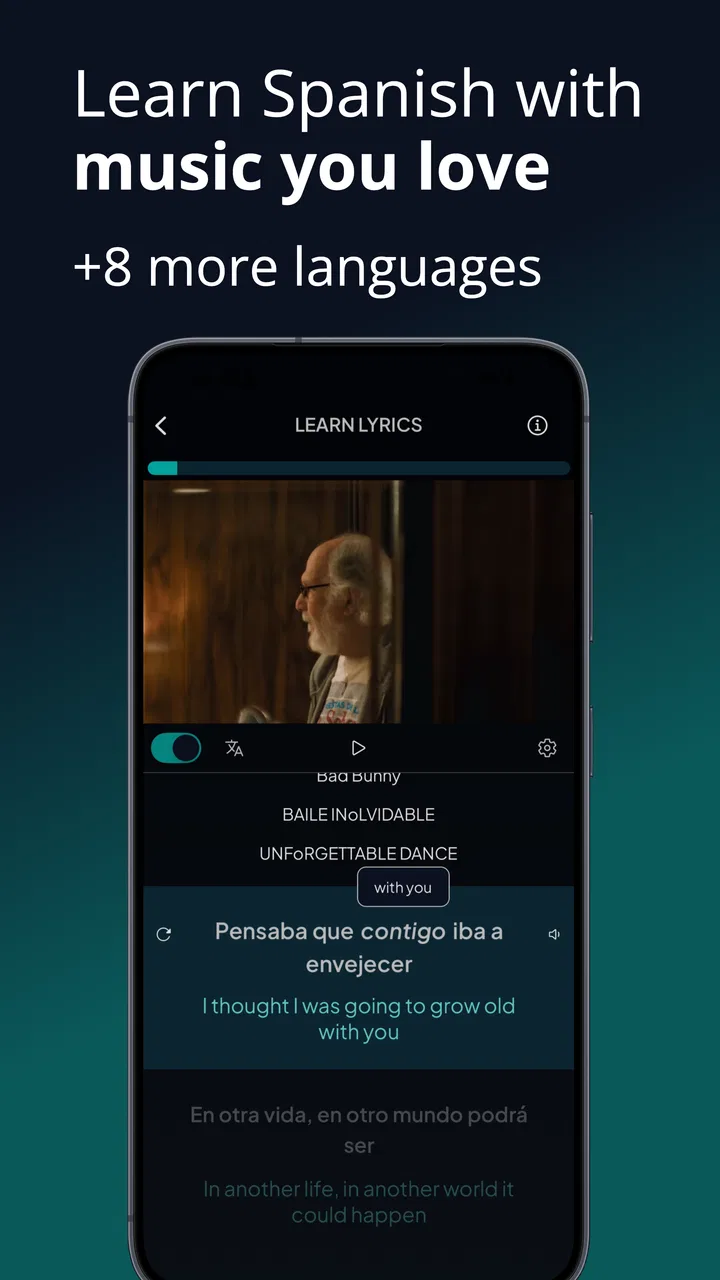
Learning through music sounds effortless, but the useful part is not simply pressing play. I found that LyricFluent works best when I treat a song as a small, repeatable language lesson: listen first, inspect the lyrics, notice a phrase, and then return to it later. That approach makes it more engaging than a standard vocabulary drill, while still requiring patience if I want real progress.
This is an education app from LyricFluent, aimed at people who want to study Spanish through music and lyrics. It also covers Portuguese, French, Korean, and other languages, so it can suit someone exploring more than one language. The app is free to start, rated for Everyone 10+, and available on Android devices running version 7.0 or later. Optional purchases range from $3.99 to $69.99 per item, which is worth remembering before building a long-term study routine around it.
How music changes the learning experience
My first impression was that the app feels less intimidating than opening a traditional course. A song gives me a reason to stay with a phrase, even when I do not understand every word. Rhythm also makes pronunciation and word boundaries easier to notice. Spanish that looks unfamiliar on a page can become more recognizable after hearing it repeatedly in a musical context.
You May Also Like

 Blood Strike: 2.5 Anniversary
Blood Strike’s Loadouts Turn Every Drop Into a Tactical Gamble
A close look at Blood Strike’s custom loadouts: how fast access to signature weapons reshapes its battle royale rhythm, rewards preparation, and narrows the gap between fights.

 Pandora - Music & Podcasts
Pandora’s Music Is Easy to Start, but Harder to Recover
Pandora’s strength is its low-effort path from a seed to a station. Its weak spot is how much confidence it asks you to place in connection, setup, and quiet recovery.

 8 Ball Pool
 Is Built on Rivalries, Rematches, and Routine
A close look at the rivalries, rematches, shared routines, and unanswered safety questions that turn a quick pool match into a persistent mobile community.

 Samsung Music
’s Quiet Strength Is Playing What You Already Own
Its reach comes less from spectacle than from dependable access to a personal library. That simplicity is both the app’s strongest retention engine and its ceiling.

 AccuWeather: Weather Radar
AccuWeather Review: A Quick, Clear Forecast for Everyday Decisions
For everyday plans, the best forecast is the one you can understand quickly. AccuWeather makes rain timing, radar, and local conditions easy to act on, with a few trade-offs.

 Hill Climb Racing
Why Hill Climb Racing Still Turns Crashes Into One More Run
A tiny car, a bumpy hill and one more upgrade: Hill Climb Racing keeps resurfacing because its simple chaos makes every near-miss feel personal.
More From Our News Desk



That convenience has a limit. Songs are not written like beginner dialogues. Singers may stretch syllables, shorten words, repeat lines, or use expressions that are natural in lyrics but less useful in a first conversation. I would not use this as my only Spanish resource. I see it as a listening and reinforcement tool that works alongside structured grammar practice, a conversation class, or a reference dictionary.
The strongest use case is someone who already enjoys music and needs a reason to return to study every day. Instead of forcing a separate lesson into a busy schedule, I can choose a track during a quiet moment and focus on a few lines. That makes the habit feel personal rather than imposed. Beginners can benefit too, provided they accept that understanding a complete song may take several passes.
When a connection becomes part of the lesson
Because the experience centers on music and lyrics, connectivity affects more than setup. When I have a reliable connection, moving between a song and its learning material feels natural. I can use a track when I am curious, follow the words, and continue while the song is still fresh in my mind. That immediate flow is one of the app’s main advantages over collecting random lyrics from the web.
The opposite is also noticeable. A weak connection can interrupt the moment when I am ready to study. If a song or lyric view takes time to load, the small amount of motivation I had may disappear. This matters especially on public transport, in a crowded café, or anywhere a phone keeps switching between a strong and weak signal. I would prepare my study choices before leaving dependable internet rather than assume every part of the experience will behave the same way offline.
This is an important distinction for travelers. A music-based lesson is attractive during a flight, a long train ride, or a walk through an unfamiliar city, but the app should not be treated as a guaranteed no-connection study kit. I plan around access instead: use it when I know the network is available, and keep a separate offline activity for vocabulary review when it is not.
Short sessions on a real phone
LyricFluent fits the way I actually use a phone better than a long desktop lesson. I can give it a few minutes while waiting for an appointment, listen during a break, or revisit a chorus before going to bed. The musical format makes a short session feel complete, even if I only work on one section.
My most effective routine is deliberately small. I listen once without stopping, then return to the lyrics and choose a handful of phrases that I would genuinely like to recognize or use. On the next pass, I listen for those phrases rather than trying to translate everything. Finally, I say them aloud after the singer. This turns passive listening into pronunciation practice without making the session feel like a test.
A realistic example would be a person commuting to work. On the way there, they listen for general meaning. During lunch, they check a line that stood out and write down its useful expression elsewhere. On the way home, they listen again and try to catch that line before reading it. That sequence is more productive than playing songs continuously in the background, because it creates a clear before-and-after comparison.
Still, phone use has its own friction. A small screen encourages quick taps rather than careful analysis, and noisy surroundings make sung language harder to distinguish. I get better results with earphones and a quiet place, but that makes the app less convenient for someone who wants completely hands-free learning. It is mobile-friendly, not magically distraction-proof.
What happens when the session breaks
Connectivity problems are not the only interruptions. Notifications, a phone call, low attention, or a song that does not match my level can break the learning rhythm. The practical recovery is to avoid treating every session as a full lesson. If I lose focus, I return to one familiar song instead of starting something new. Familiarity lowers the effort needed to resume.
I also recommend keeping a simple personal record of phrases that matter. The app can provide the listening context, but my own notes make recovery easier when I cannot open it immediately. I might record the phrase, a rough meaning, and one situation where I could use it. That prevents a useful expression from disappearing just because the connection failed at the wrong time.
Another helpful habit is to separate discovery from study. When I have good internet and enough time, I explore songs and decide which ones deserve repeated attention. Later, if the network is unreliable, I do not waste the session searching. I already know what I want to practice. This workflow reduces dependence on browsing and protects the limited motivation that often comes with a short mobile session.
The app is therefore better for flexible learners than for people who need a strict, uninterrupted course path. If a lesson stops halfway, I can recover by returning to the song, but I do not get the same sense of linear progress that a conventional textbook or tightly sequenced language platform provides. That trade-off is central: the music makes practice inviting, while the learner must supply more structure.
Using it without wasting mobile data
A music-focused app can encourage longer sessions than a typical flashcard tool, so data-conscious users should be intentional. I would avoid leaving songs running when I am not actively listening, especially on mobile data. A focused repetition of one track teaches me more than letting a large queue play in the background.
Wi-Fi is the sensible choice for exploring unfamiliar music or switching frequently between songs. On cellular data, I would choose a specific track, keep the session short, and avoid repeated browsing. The point is not to make the app inconvenient; it is to match the connection to the task. Studying one chorus carefully is both more educational and less demanding than casually sampling everything available.
Battery use is another practical consideration whenever listening and screen interaction happen together. I would lower screen brightness, close unrelated apps, and avoid studying with dozens of interruptions. These are ordinary phone habits, but they matter more when a language session depends on audio and a live connection at the same time.
I also would not assume that a strong signal automatically means a perfect experience. Network quality can change inside buildings, underground, or in crowded areas. If a lesson matters, I start it before moving into a poor-signal location and leave myself enough time to repeat the material while the connection is stable. That small adjustment makes the app feel much more dependable.
Who will get the most from it?
I would recommend this app to music lovers, casual learners, travelers preparing their ears for Spanish, and intermediate students who want more natural listening material. It is especially useful for people who struggle to maintain interest with isolated word lists. Hearing a phrase attached to melody gives it a stronger memory hook than seeing the same phrase once in a flashcard deck.
It can also help someone compare languages. Since the app includes Portuguese, French, Korean, and more alongside Spanish, a curious learner can use music to notice how different languages sound and how familiar patterns change. I would keep one main target language, though. Switching too often may be entertaining but can dilute progress if the goal is conversational ability.
I would skip it as a primary choice if I need a formal curriculum, detailed grammar explanations, speaking feedback, or a guaranteed offline workflow. A dedicated course is better for progressing through clearly ordered levels. A flashcard app is better for high-volume vocabulary repetition. A pronunciation coach is better when precise correction is the priority. LyricFluent occupies a different space: it makes listening practice easier to return to.
What the current release means for new users
The app’s current version is 3.369.0, and its overall reception is strong, with a 4.8 average from around 4K ratings. It has passed 100K installs, which gives me some confidence that it is not an abandoned experiment. The developer is LyricFluent, and the app has been available since June 3, 2022.
Those figures do not replace personal testing, but they provide useful context. I would still begin with the free experience and check whether the song-based method suits my attention span before considering an optional purchase. The purchase range is broad, so I would read each offer carefully rather than assume every learner needs the most expensive option.
The Everyone 10+ rating makes it approachable for many learners, including families choosing an educational music app, but adults should still guide younger users toward suitable songs and study habits. The rating describes general suitability; it does not turn the app into a supervised language course.
My practical verdict on connectivity
Connectivity shapes LyricFluent more than it would a basic dictionary or flashcard app. A good connection supports discovery, immediate listening, and a smooth move between music and lyrics. A poor one can break concentration, particularly when I have only a few minutes available. The best approach is to use the app deliberately: choose material while connected, focus on short repetitions, and keep personal notes for moments when the phone cannot cooperate.
After using it this way, I see the app as a genuinely enjoyable supplement rather than a complete replacement for language study. Its biggest strength is emotional: music gives me a reason to come back. Its biggest weakness is that songs and mobile connectivity both introduce variables that a structured lesson avoids. If you want Spanish practice that feels less mechanical and you are willing to add your own routine, I think it is worth trying for free.
My recommendation is simple: use LyricFluent when you want to train your ear through songs, not when you need every part of a language course in one place. With a stable connection and a focused listening plan, it turns spare minutes into memorable practice. Without that plan, it can easily become background music with attractive lyrics, which is pleasant but far less educational.
FAQs for LyricFluent: Learn Spanish
01What is LyricFluent: Learn Spanish and how does it work?
LyricFluent: Learn Spanish is a language-learning app that uses Spanish songs and lyrics as the main learning material. After choosing a song, you can follow the lyrics, read translations, review vocabulary, and practice understanding Spanish in context. It is designed to make learning more engaging by combining music, repetition, listening practice, and explanations rather than relying only on traditional lessons.
02Is LyricFluent suitable for complete beginners in Spanish?
Yes, beginners can use LyricFluent, although the difficulty may vary depending on the song selected. The app can help new learners become familiar with pronunciation, common expressions, and everyday vocabulary through repeated listening. However, songs sometimes include slang, shortened words, or poetic phrases, so absolute beginners may benefit from using the translations and explanations alongside a basic Spanish course or grammar reference.
03Can I learn Spanish grammar and vocabulary with this app?
LyricFluent can support vocabulary development and help users notice grammar patterns in authentic Spanish, especially through repeated lyrics and contextual examples. It is particularly useful for learning phrases, verbs, pronunciation, and conversational expressions. Nevertheless, it should not be considered a complete replacement for a structured grammar program, since music-based learning may not cover every tense, rule, or language skill in a systematic order.
04Does LyricFluent require an internet connection or offer offline learning?
An internet connection may be needed to browse available songs, load lyric content, synchronize progress, or access certain learning features. Offline availability can depend on the app version, subscription plan, and the specific content provided by the developer. Before downloading songs or relying on the app while traveling, check its current store description and in-app settings to confirm whether offline access is supported.
05Is LyricFluent: Learn Spanish free to download and use?
The app may be free to download, but some lessons, songs, learning tools, or advanced features can require in-app purchases or a subscription. The exact pricing and limitations may change over time, so users should review the Google Play Store or Apple App Store listing before installing. Also check the trial conditions, renewal terms, and cancellation process if a subscription is offered.
Pros
- Short lessons make it easy to practice Spanish during spare moments.
- Learning through song lyrics can improve listening and pronunciation naturally.
- Vocabulary is introduced in a memorable
- music-based context.
- The format feels more engaging than traditional flashcard exercises.
- Useful for learners who enjoy combining language study with music.
Cons
- Song-based learning may not cover enough grammar for complete beginners.
- Some lyrics can include slang
- abbreviations
- or culturally specific references.
- Progress may depend on having enough time to listen and repeat songs.
- Music preferences can affect how enjoyable the available lessons feel.
- A stable internet connection may be needed for streaming lesson content.

LyricFluent: Learn Spanish
Gallery